Homily for Wednesday of the 10th Week in Ordinary Time, 10 June 2020, Mat. 5:17-19
We have a funny scene in our first reading. One Israelite prophet challenging 450 prophets of Baal and 400 prophets of Asherah (850 in all), to something like a duel. The King of Israel, King Ahab, had already abandoned the faith and turned to the Canaanite fertility gods, Baal and Asherah. He and his wife, the Queen Jezebel, had ordered the massacre of all the prophets of Israel, and only one remained, the prophet Elijah. He had been in hiding, until God instructed him to come out and confront King Ahab. So he turned himself in, but not without a fight.
Elijah, in today’s reading from the first book of KIngs challenges the fake prophets to a different kind of marathon. Pray to your gods and I will pray to Yahweh my God, and we’ll see, who of us will be heard.
This Canaanite fertility religion had become so popular to the Israelite men because it legitimized their infidelity to their wives. They were made to believe that in order to make the earth fertile, they had to ritualize the union between Baal, the father God, who represented heaven, and Asherah, the mother goddess who represented the earth. They could hire a temple prostitute for sex, and this was done as a sort of religious duty, believing that it was the only way to get their fields to be fruitful. They called it sacred prostitution.
Back to the Elijah challenge. He tells the Baal prophets to do what they are used to doing: they dance, they leap around on one foot, circulate around the altar while chanting and shouting. They even had this strange practice of inducing a trance by making little cuts on their bodies and making themselves bleed. And the author says, nothing happens. Twice, he says, “There was NO VOICE.” Meaning, God could not be heard through them.
They were a bunch of fakes who would do whatever was pleasing to the King. They pretended to pray as if grace depended on their gimmicks, their rituals, their techniques, their sacrifices and the combination of their words. What do they obtain? NOTHING.
Remember, Jesus once said in Matthew 6:7 “When you pray, you do not have to babble like the pagans, who think that they will be heard because of their many words.” In short, you don’t manipulate God or treat him like a puppet on a string or like a jukebox that plays a tune when you drop a coin in it. Elijah did not do any of that.
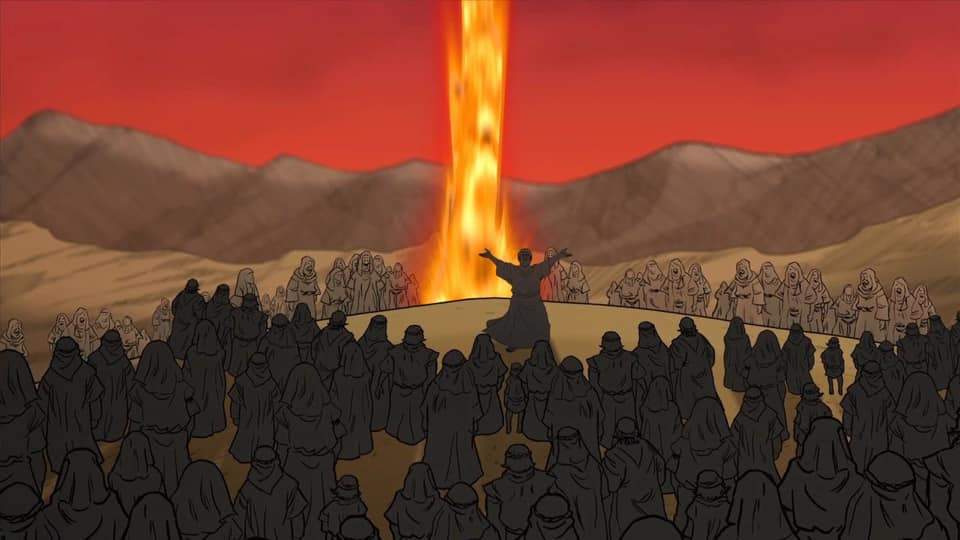
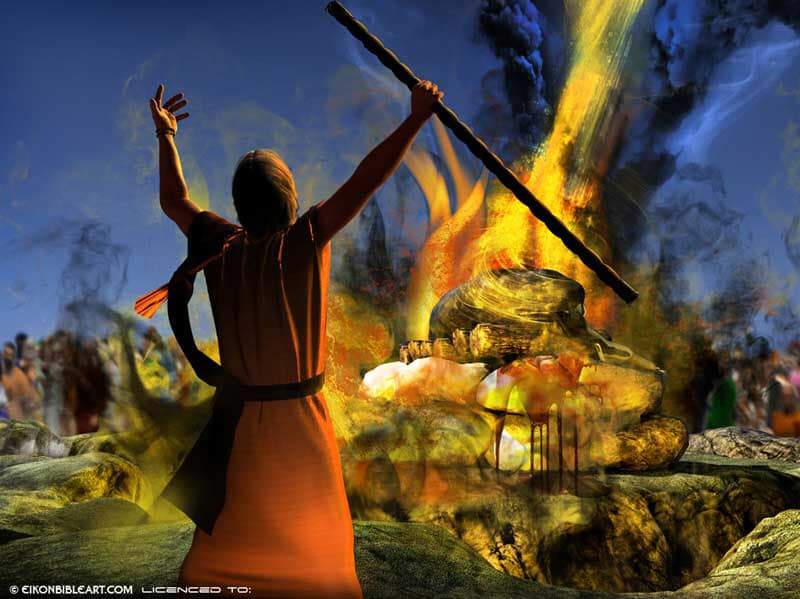
When it was his turn, he just called on the Lord’s name and fire descended upon the altar and burnt up the offerings.
Fire was the symbol of the temple. When Solomon built the temple, a perpetual fire was made to burn in the holy of holies. Our vigil lamps in our parish Churches are a remnant of that tradition of the perpetual fire of the temple, which was supposed to be kept burning by the priests. The symbolism is quite evident, the fire of the divine presence. It is what people come to the temple for: in order to find light in their darkness, in order to seek warmth in the cold, in order to be transformed and purified like gold tested in fire.
Inside the temple, in the Tabernacle of the Holy of Holies, there was the Ark of the Covenant. Inside this box, they placed the two stone tablets of the Law that Jesus is speaking about in today’s Gospel. Remember how we heard this a few days ago? How Jesus had summarized the Jewish law into two: LOVE OF GOD and LOVE OF NEIGHBOR.
Many people reacted with what they thought was an oversimplification by Jesus. Was he abolishing the law? Today, he answers that and says, he came not to abolish the law but to fulfill it. In the words of the prophet Jeremiah 31, God says that in the new covenant, he will write his law, no longer on stone tablets, but rather “in their minds and hearts.“
The Lord eventually allowed this temple of stone to be demolished so that we ourselves could become the new temple. When our hearts are aflame with Love of God and neighbor, that’s when we become God’s temple and fulfill the prophecy of Jeremiah.
And so we end with the question, HOW SHOULD WE PRAY? Let go of the gimmicks. It is not what you do for God that matters; it is rather what you allow God to do for you and through you. Like Elijah, go rather for the simplicity of disposing your heart to trust in God as a child entrusts who himself totally in his Father’s loving hands. When you can pray as if everything depended on God, you can work as if everything depended on you.”