
THE MISSIONARY

Ibalik sa May-ari ang Nararapat
October 18, 2020
Ang Tunay na Mayaman
October 19, 2020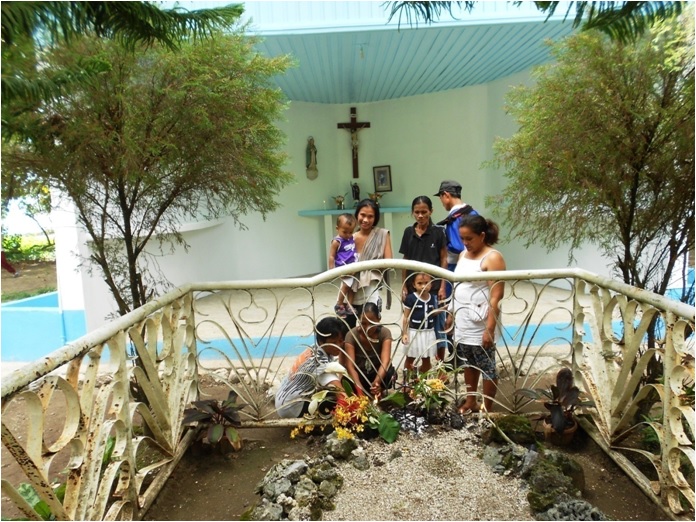
I met him in 2013. It was not a face-to-face meeting. I came to know this missionary through stories told by his devotees. He has long passed on – almost four centuries earlier. His gravesite was one of the stops in a tour of heritage sites of the Diocese of Dipolog (as part of the 8th Biennial National Convention of Church Cultural Heritage Practitioners). In that conference, the Diocese expressed its interest to know more about the growing devotion to this missionary to be able to provide theological and spiritual guidance to the devotees.
Having been involved in a number of studies on church heritage especially on rituals attached to devotions to saints in my home province of Pampanga (e.g. Kuraldal in honor of St. Lucy and Libad Bangka in honor of St. Peter), I volunteered to help. This case was unique. All the rituals and devotions I had studied were devotions to full-fledged saints – officially recognized by the Vatican. This one involves a non-canonized figure.
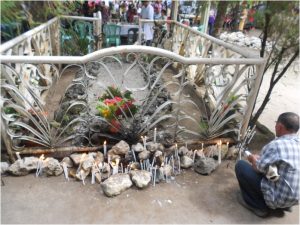
Gravesite at Jose Dalman (formerly Ponot), Zamboanga del Norte believed to be the gravesite of Fr. Francesco Palliola, SJ
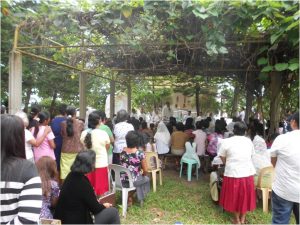
Devotees attending mass on Fr. Palliola’s death anniversary (every January 29)
People do not even care if it is an empty grave. Every January 29, his death anniversary, people trek to his gravesite for a mass then to light candles and offer prayers in honor of the priest they have never met, but whom they believe to be a powerful ally who intercedes on their behalf to gain favors (e.g. healing, good harvest, protection, etc.) from the Divine. Among those who come annually are Subanens and non-Catholics who have to walk for about two hours to reach the gravesite.
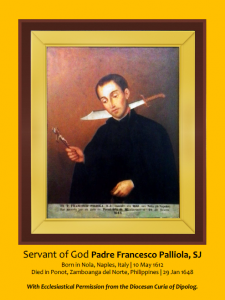
The missionary’s name is Fr. Francesco Palliola, SJ., an Italian Jesuit. He is the main character in a phenomenon that has been happening in Ponot (now Jose Dalman) in Zamboanga del Norte since time immemorial. He descended from an ancient line of nobility in Nola. He opted to leave all material trappings of wealth behind to sail to the East to spread the Gospel in far-away Mindanao. He found inspiration in the life and ministry of Fr. Marcello Francesco Mastrilli, another Italian Jesuit and native of Nola who heeded the call to minister to non-Christian communities in Japan and ended up being martyred for it.

Image of a 1642 letter from Fr. Francesco Palliola addressed to his mother (From the Palliola Family Collection)
Chronicles by Fr. Palliola’s fellow Jesuits and correspondences with family members (that are well-preserved to this day) reveal his zeal and dedication to the mission that he wholeheartedly embraced to the point of death in the hands of those he attempted to minister spiritually – the Subanens. From his biography and personal exchanges (letters) with his family and friends, it is now known that Fr. Palliola had communicated his strong desire to be a witness and to die for the faith. He constantly referred to himself as “your unworthy servant.” Fr. Palliola is acknowledged as the first European to learn the local language (in his case, Subanen) and use it to communicate effectively with the people in his mission station, a pastoral strategy that was widely adopted by missionaries of his time in various parts of the Philippines.
Evangelization Trail
Part of the research was to trace the evangelization trail that Fr. Palliola took. I worked with a team of Dipolog-based volunteers led by Fr. Patrick Dalangin of the Diocese of Dipolog who took on the tasks of facilitating logistical arrangements, coordinating with research participants, and acting as translators during interviews. My knowledge of the local language (Cebuano) was enough for me to comprehend the interviewees’ responses but I was not fast enough to capture everything in writing.
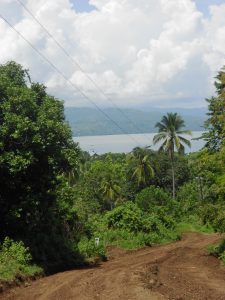
Photo taken at Brgy Bitoon (meaning Star), overlooking Sindangan Bay and Liloy Point. Sindangan Bay and Liloy Point are part of the usual route of Palliola’s nautical highway to Quipit (a barrio now of the present day Labason), a visita of Fr. Palliola’s Missionary Journey.

Photo taken in Malintuboan, Labason, Zamboanga del Norte. Fr. Palliola used to pass this body of water in going to Quipit.
Our starting point was Ponot then on to Sindangan Bay to Liloy to Quipit. It took us almost the whole day aboard an old sports utility vehicle to reach these points. Some portions of the road were rugged; some portions were well-paved. It was easy to imagine how it was like in the 1600s when Fr. Palliola set foot in Mindanao soil. To get from one point to another, he had to travel on horseback, by foot or by boat/ship across a wide area that was heavily-forested terrain on one hand and water-locked on the other.
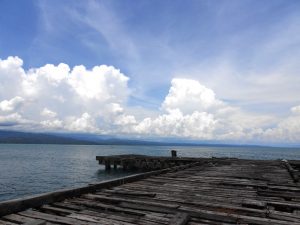
Photo taken at Brgy . Calatunan in Sindangan, Zamboanga del Norte. showing a view of Sindangan Bay
It was after this research activity when I found the answer to the questions I had in my mind at the start of this study. What were his virtues to merit such devotion? Fr. Paliolla’s love of God and the Christian faith was such that it nurtured in him an unwavering dedication to his mission, perseverance, and courage to withstand the discomforts and confront the challenges that came his way. In our country where the collective memory paints a caricature of missionaries and friars as abusive instruments of colonization, Fr. Palliola’s ministry proves otherwise.
Many years of exposure to archival research about Augustinian missionaries’ work in the Philippines where I enjoyed access to original handwritten documents in archaic Spanish have made me appreciate the sacrifices and contributions of those who paved the way for Christianity to take root in the Philippine islands. The work of Jesuits in far-flung areas of Mindanao is as sublime; maybe more so given the realities of Mindanao as a melting pot of cultures and as home to various ethno-linguistic groups subscribing to varying faiths (e.g. animism, Christianity, Islam, etc.)
Walking with Jesus
Almost four centuries since Fr. Palliola’s martyrdom, peace continues to evade the Mindanao Island where religious extremism and terrorism come into play; yet, despite the threats and the challenges, missionaries continue to do their work of spreading the Gospel. Today’s pastoral strategy goes beyond preaching and converting people to the Catholic faith; it has evolved into a dialogical type of engagement where people of various faiths are interested to find their commonalities rather than harp on their differences.
Jesuits have played a significant role in shaping the Mindanao of today through the establishment of institutions of learning (e.g. Ateneo de Davao, Xavier University, Ateneo de Zamboanga) and through outreach/mission work in marginalized communities at the fringes of Mindanao society. The good harvest that the Catholic Church in Mindanao is reaping today is fruit of the seeds sown by missionaries of yesteryears. By remembering them and their virtues, the present generation arms itself with wisdom and insights that could guide its outlook and shape its character.
Fr. Palliola becomes all the more relevant in the modern world where materialism prevails. Giving up a comfortable life and venturing into a foreign land at a time when modern technology was just a dream, Fr. Palliola’s life and ministry can serve as inspiration particularly among clergy and wo/men religious missionaries who strive to fulfill their mission and remain true to their vocation with unwavering dedication and zeal.
Today’s missionary work involves bearing witness to the Word wherever one may be, whatever one’s profession is, as long as Christ lives in him/her, by his/her words and actions. With this, the Word is transformed from virtual to real. It comes alive not by imagination but by experience. To those among the laity who are steeped in the tradition that the Catholic faith is consummated within the confines of the church alone, Fr. Palliola’s life and ministry comes as a challenge to plunge in at the deep end without fear. It is in the fringes of society where one gets to walk with Jesus every single moment of his/her life.


