
GATEWAY TO THE PAST

WHAT HE DID FOR LOVE
September 14, 2020
THE GRIEVING MOTHER
September 15, 2020
Not many are aware that the Archdiocese of San Fernando (Pampanga) has a DIGITAL COLLECTION of Spanish-era documents in its archives. When Bp. Ambo David was head of the Heritage Commission, we proposed a project to the National Commission for Culture and the Arts (NCCA) in partnership with Holy Angel University-Center for Kapampangan Studies (HAU-CKS) and in coordination with the Archdiocesan Archives of Manila (AAM), the National Library of the Philippines (NLP) and the National Archives of the Philippines (NAP). NCCA approved our proposal. The team was composed of Bp. Ambo David (Consultant), Msgr. Eugene Reyes (Archdiocesan Archives Director, Karen Shih (Assistant Researcher), Nina L. B. Tomen (Project Coordinator/Lead Researcher) and Myra Lopez (HAU-CKS representative). We spent a year working on quite a daunting task.
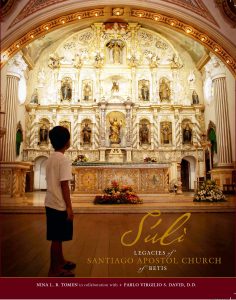
The idea cropped up when I was working on the coffeetable book “Suli:Legacies of Santiago Apostol Church of Betis”. Fellow researchers (among them Edna Gueco and Francis Musni) told me to check out the Archdiocesan Archives of Manila for Spanish-era documents. I went through the application process until I got the nod of AAM Director Fr. Albert Flores through Mr. Bernie Sobremonte to do research at the AAM in Intramuros.
The first time I held an archival document with my gloved hand (AAM requires researchers to wear gloves to avoid further damage to the centuries-old documents), I was in awe, almost in shock. My hands trembled and my heart skipped a beat. I inhaled deeply to take in the smell of old paper (although the smell of vinegar pervaded the air inside the area because of ongoing preservation of microfilms) before I began to browse the book oh-so-carefully. It was a thick book dated 1680 that ushered me into the old world and kindled a love affair with archival materials. While I was browsing through the material, my mind was filled with images of the past – of friars and gobernadorcillos, of heroes, villains and traitors.
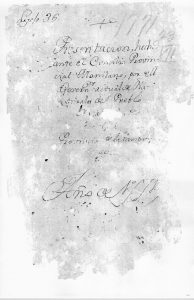
Trips to AAM became part of my weekly routine in 2011. Doing archival research at that time was like looking for a needle in a haystack. A good part of the archival materials was unclassified and unorganized. My eyes ached from too much straining to understand the handwriting of various individuals. I always came home tired from the long trip but I was richer in perspective owing to discoveries about the way the Catholic Church conducted its affairs from the Spanish era down to the American era. It erased my biases against the friars who’ve always been caricatured as abusive, power-hungry and unworthy of their vocation.
The archival documents, considered as primary sources of information, revealed the following:
- Church authorities regularly made pastoral visits that took days to complete because there were no cars and jeepneys at that time. They rode in calesas and endured long trips to complete their task of visiting the parishes one by one.
- The parish priests regularly reported on the number of “souls” under their care.
- With these pastoral visits came the inventory of goods where church resources were listed down along with the condition of these goods— from the most significant like the retablos to every day stuff including kitchen utensils.
- There was proper accounting of all funds. Construction projects necessitated the submission of plans and bill of materials for approval of the bishop. The documents came with the name of the appointed person-in-charge as well as names of workers.
- Every move that the parish priests made had to be properly acknowledged and approved by the Bishop. Pampanga was initially under the Archbishop of Manila until the 1948 Apostolic Constitution created the Diocese of San Fernando that initially consisted of the Provinces of Pampanga, Zambales, Bataan and some parts of Tarlac and Nueva Ecija.
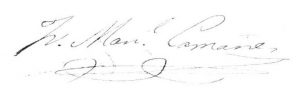
- Pampanga was handled by the Augustinian missionaries. These people used their talents and know-how not only to fill the spiritual needs of their parishioners but their corporal needs as well. Among the notable ones are Fray Manuel Camañes, O.S.A. who built the first artesian well in the Philippines (at the Betis Church compound); Fray Guillermo Masnou, O.S.A. during whose term as Parish Priest of Angeles City the silver sunburst of Angeles City’s Pisamban Maragul was installed; Fray Casimiro Diaz, O.S.A. who took over the work of recording events as chronicler from Fray Gaspar de San Agustin, O.S.A.
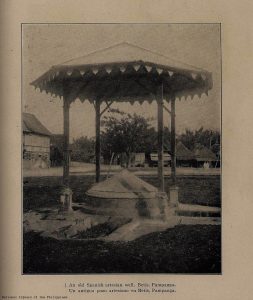
Artesian well in Betis (From the collection of the National Library of the Philippines). Fray Manuel Camañes, O.S.A. built the first artesian well in the Philippines.
- Erection of parishes entailed a detailed study of the need, the situation, the location, and circumstances.
- Some of the friars, like Fr. Fernando Garcia, O.S.A., were taken as prisoners by revolutionary forces. Many of them were tortured and killed.
- It goes without saying that there were also bad eggs in the church as it is with all human organizations. Cases of abuse were properly documented and addressed by the Bishop.
I can go on and on about the discoveries that I made from my archival research. Most of those discoveries can be found in the coffeetable books that our team (now officially known as The Storytellers’ Society, Inc.) produced.
I ordered photocopies of the archival documents, took these back to Pampanga and showed them to Bp. Ambo. He agreed to translate the text that I needed for the Betis book. It helped that I had 6 units of Spanish in college and 3 units of Spanish in high school under the well-loved Sra. Bas. My Lola Ya also taught me the Spanish alphabet along with some Spanish words when I was in elementary. It also helped that my own handwriting is barely legible – what others would refer to as kalkal manok. Most of the entries in the archival documents are handwritten in archaic Spanish. Some are barely legible.
“Can we bring home our archival documents? Just the scanned copies because the original are in good hands at the Archdiocesan Archives of Manila.” I posed the question to Bp. Ambo in one of our conversations. He thought it a good idea and he got in touch with His Eminence Gaudencio Cardinal Rosales, then the Archbishop of Manila, to ask for permission. “Do it now, while I am still here,” came his reply. He readily agreed to allow us to do an inventory and acquire photocopies of materials about Pampanga.
We began working on the archives project on February 1, 2011. In 2012, as the Archdiocese of San Fernando celebrated 440 years of Christianization of Pampanga, we launched the twin projects—Archdiocesan Archives Digital Collection and Suli coffeetable book on March 20, 2012 and August 27, 2012 respectively.
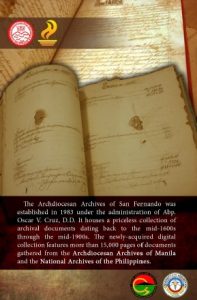
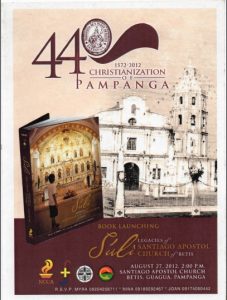
The archives project yielded the following output:
- Digital collection featuring more than 15,000 pages of digitized documents and photographs from the Filipinas Heritage Library, Venancio Q. Samson collection, Center for Kapampangan Studies Archives & San Agustin Museum, the National Archives of the Philippines, Archdiocesan Archives of Manila, and Archdiocesan Archives of San Fernando
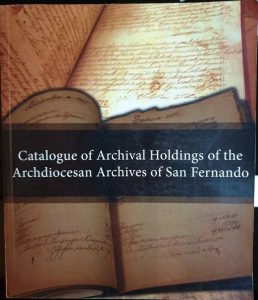
- Inventory/Catalogue of ASF archival holdings
The University of the Assumption, which was then headed by Auxiliary Bp. Roberto Mallari, agreed to house the collection and provide funds for initial operations. The Archdiocese of San Fernando later bought its own digital scanner to continue digitizing its canonical books and other documents.
The Archdiocesan Museum was established in 1979 and the Archdiocesan Archives of San Fernando in 1983 with the help of Prof. Regalado Trota Jose and Sr. Paz Katigbak, O.S.B. during the term of Abp. Oscar V. Cruz, D.D. The archival documents were gathered, sorted, classified according to source parish, book-bound and stored in boxes that were temporarily deposited at the Mother of Good Counsel Seminary in the City of San Fernando, Pampanga. The collection was not accessible to the public during that period.
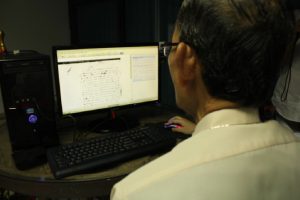
Apu Ceto (who was then the Abp. of San Fernando) browses through the digital collection during the launch.
It has been eight years since the digital collection was launched. I only covered 70% of AAM’s holdings. There is a lot more to be done. Building of our gateway to the past is a work-in-progress. In 2022, the Archdiocese of San Fernando will celebrate 450 years of Christianization of Pampanga. What better way for church heritage scholars and researchers to celebrate this event than to dig deep into the repository of primary sources of information and piece together the history of their respective parishes?
“Heritage conservation has that power to connect us with our past and with others. It is a helpful tool in acquainting ourselves with the spirit that nourished our forebears spiritually and culturally. It allows us to explore new expressions of faith while allowing us to touch base with our roots.” (NLBT, 9/14/20)


