Homily for 11 September 2020, Friday of the 23rd Week in Ordinary Time, Lk 6:39-42
Last Sunday we heard about the Christian duty and obligation to practice fraternal correction in our communities. I mentioned that admonishing the wayward is listed among the spiritual works of mercy. By implication, we also mentioned that doing nothing to correct a fellow disciple who you know is doing something wrong is considered as a SIN OF OMISSION.
Yesterday we heard what I call a conscious effort on the part of Jesus to balance fraternal correction as a moral duty. Even as we admonish the wayward, we also have to make sure we don’t do it in a judgmental way. Remember the famous lines, “Do not judge and you shall not be judged. Do not condemn and you shall not be condemned… For the measure with which you measure will be measured out to you.”
You see, there is a very thin line that distinguishes righteousness from self-righteousness. There are many instances in the Gospels when Jesus himself was judged or condemned by the vanguards of righteousness in Israelite society, such as the Pharisees.
The Navajo Indians of the American Southwest have a saying that goes, “When you point an accusing finger on somebody, do not forget that three others are pointing at you!” I think it is basically what Jesus himself meant when he told the men who wanted the woman caught in adultery to be stoned to death. The Gospel tells us Jesus said in reply, “Let the one among you who is without sin be the first to cast a stone.” (John 8:7) And they all went away.
There was once priest who told me that he was approached by one parishioner after Mass. Apparently the lady parishioner complimented him for his homily. This is what she said, “Ang daming tinamaan sa homily n’yo, Father. Sana matauhan talaga sila.” (Father, your homily was a bulls-eye; it hit a lot of people I know, Father. I wish it awakens them.) The priest just smiled. He restrained himself from answering, “But it was meant for you, my dear.”
I was a guest this morning at Radyo Veritas in the program of Angelique Lazo and Fr. Luciano Feloni. In his reflection on this Gospel, Fr. Luciano called attention to “funny way” in which Jesus expressed his criticism of the common human tendency to do fraternal correction in a manner that is not only judgmental but also hypocritical. He was right. It looks like one of the reasons why Jesus was able to criticize people constructively was, he often also did it with a sense of humor.
Listen to how he said it jokingly: “Imagine noticing a speck in another person’s eye and missing a whole log of wood in your own eye?” He is of course exaggerating; can you even imagine a whole log in your eye? Most likely he said this with the deliberate intention of making his audience laugh, so that he could make them think seriously about it afterwards.
In another instance, he spoke about people who go out of their way to “strain a tiny insect from their drink while they swallow a whole camel”. And once, as he preached against the tendency to be too preoccupied with material things, he said, “Look at the birds of the sky—they do not sow nor reap nor gather ito barns…Or the lilies of the fields, look, they do not work or spin or weave clothes, but even Solomon in his glory was never clothed like one of them…” Jesus says it in a funny way , talking about birds doing farming or wild flowers weaving clothes, because it is easier for people to take it that way—with a grain of humor.
This must be the reason why Saint Paul says in our first reading that, even if he preaches the Gospel, it is no reason for him to boast. And I agree with him. Sometimes, in the middle of your own preaching, you feel convicted by the very words you utter. And so he says, “To the weak, I made myself weak, in order to win the weak.”
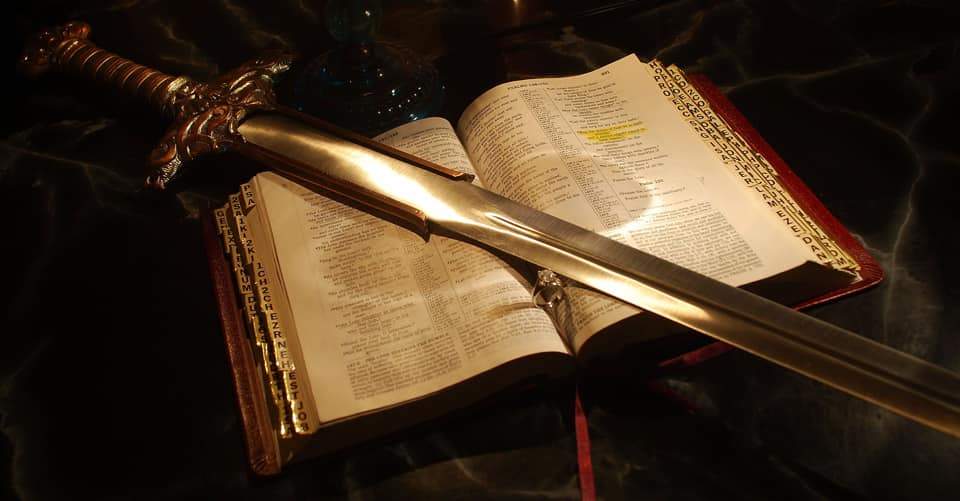
In Hebrews Heb. 4:12, the writer says, “For the word of God is living and active. Sharper than any double-edged sword, it penetrates even to dividing soul and spirit, joints and marrow; it judges the thoughts and intentions of the heart.”
If it cuts through the mind of the hearer, the other edge cuts through the soul of the preacher himself.