LET IT BE

PLEASE, I CAN’T BREATHE
May 31, 2020
INNOCENT AS DOVES, CLEVER AS SERPENTS
June 2, 2020Homily for the Memorial of Mary, Mother of the Church
Monday of the 9th Week in Ordinary Time, 1 June 2020, Jn 19:25-34
Today’s memorial of Mary, Mother of the Church, reminds me of my youthful days in the College Seminary, when once, during our community Mass, I took the liberties of choosing a secular song to conclude our Wednesday Novena to Our Lady of Perpetual Help. We sang Paul McCartney’s LET IT BE, and we got reprimanded for it.
The priest who called our attention about it told us that he had read an article explaining the real background of the composition—that the Mary that was referred to in the song had nothing to do with the Blessed Mother. That it was actually referring to “marijuana”, the common gateway to substance abuse which many popular musical bands were identified with during those years.
During that time Google did not exist yet so we had no quick way of checking on the veracity of such a claim. You can imagine therefore my great delight when, decades later, I watched an actual interview of an older Paul McCartney in which he revealed what the song was really about. It was about his mother, Mary Mohin McCartney, whom he lost at the age of 14. He said he saw her in a dream around the time that the friendship of the Beatles was beginning to collapse, and he felt deeply affected by it.
You see, it is a common phenomenon among rock bands after they reach the height of their popularity and success gets into their heads, that they begin to compete with each other and eventually end up with a parting of ways. Remember how John Lennon even arrogantly claimed that the Beatles were more famous than Jesus Christ?
Paul Mc Cartney said in that interview about the songs he had composed for the Beatles that he saw his mother in a dream assuring him it was going to be all right, and that all he needed to do was let go, let things be. And so LET IT BE was born.
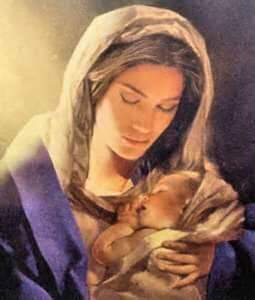
The song may not really be about Mama Mary, but Paul’s intimacy with his long-departed mother inevitably tugs the hearts of Catholic Christians. It makes us think of a spiritual mother whom we also see, not just in our dreams but in our prayers as well.
Some of those following these online Masses who may have been estranged from the Catholic faith might want to know why Mary is such an important aspect of Roman Catholic Christianity. It’s package deal for us, you know. The mother goes with the son.
Because we confess her Son as the Christ, the Son of God, our Lord and Savior, because we have received his gift of the Holy Spirit and have become part of his Body the Church, we also get to love his mother as our own mother.
In flesh, we are of course no different from the rest of humanity whom we call “the sons and daughters of Eve”. But when we refer to ourselves as Children of Eve, we refer to our old, unredeemed humanity. That is why in the prayer that concludes the Rosary, the HAIL HOLY QUEEN, we refer to ourselves as the “poor banished children of Eve.” Banished from paradise.
But in Spirit, we call ourselves “Children of Mary,” the mother of the new humanity in which we are called to be reborn—the humanity in the image and likeness of Jesus Christ, Son of God and Son of Mary. And so, to be a Roman Catholic is to be unabashedly Christian and unashamedly Marian, at the same time. But please, make no mistake about it. We don’t worship her; we just love her like we love our own mothers.
The Gospel for today’s memorial of Mary, Mother of the Church, explains why. We identify ourselves with the figure whom the evangelist calls the Beloved Disciple, who was entrusted by Jesus to his Mother. “Woman, behold your son.” John uses the word WOMAN, precisely to establish her parallelism with Eve.
At the risk of being simplistic, I think of the Beloved Disciple character of the fourth Gospel as something like a cardboard standee with a blank face. You stand behind the standee with the picture of Jesus standing next to you, with his hand on your shoulder, and the Beloved Disciple becomes you.
In the Catholic tradition, to be a Christian is to be a brother and friend of Jesus, and whoever finds a brother or friend in Jesus also finds a mother in Mary. They become children of Mary, Mother of the Church. That should also make you understand why, when we listen to Paul McCartney’s song, we take the liberties of identifying Paul’s Mother Mary with that of Jesus, and to whom Jesus has entrusted us, while his mother stood at the foot of the cross. In truth, “when we find ourselves in times of trouble” like this terrible pandemic crisis that is besetting the world, “Mother Mary comes to us,” not just in our dreams but in our prayers. She is “speaking words of wisdom”; she says, LET IT BE.
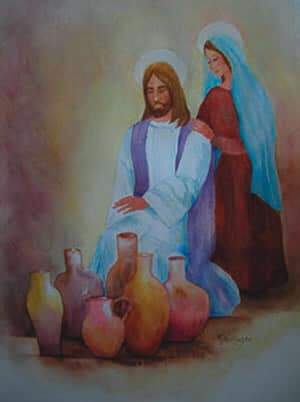
“And in our hours of darkness” she is “standing right in front of us”. Her message is pretty much the same as what she told the servants at the Wedding Feast at Cana, DO AS MY SON ASKS OF YOU, nothing else. And so, when she tells us LET IT BE, we take it to mean that we should be ready to take part in her Son’s redemptive suffering and death. She tells us not to be afraid of it, because it merely prepares us for our rebirthing into the our new humanity as sons and daughters of God.
In Latin, the text that we read today in the Gospel is called the STABAT MATER. I have one artist friend who once proudly showed me his version of the STABAT MATER. It was beautiful, except that the Blessed Mother was lying in the arms of John. He called it a Pinoy version, “Hinimatay daw si Mama Mary.” (Mama Mary had passed out. ) This is a typical scene in Pinoy funerals. I had to explain to him that STABAT MATER literally means, “The Mother was standing at the foot of the cross.” Meaning, she stood her ground up to the very end. That she was a brave woman, a woman of courage, the same woman who boldly declared her first LET IT BE. She said, “Let it be done to me according to your word.” She had to give birth to her son both physically and spiritually. Physically in Bethlehem, and spiritually in Jerusalem, on Calvary.
And so she had to be there all throughout until Easter, Ascension and Pentecost. Her mission which began with her Son goes on with the Church. She had to be there also at the birthing of the Church, bearers of the new humanity, followers of the Way of Jesus. She who is “full of grace” will not be deceived by the Serpent ever again. Because “the Lord is with her”, she will crush the serpent’s head. She who is “Blessed among women”will protect the birthing of the new humanity in Christ, the “Blessed fruit of her womb.”
If you are not comfortable with LET IT BE, there is Marian song, that expresses basically the same thing. It is a lovely song that expresses who Mary is for us:
Gentle woman,quiet light,
morning star, so strong and bright,
gentle mother, peaceful dove,
teach us wisdom, teach us love.
You were chosen by The Father,
You were chosen for The Son,
You were chosen from all women,
and for women, shining one.