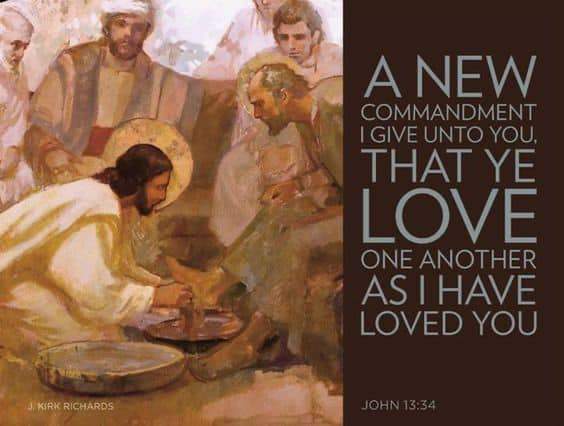
THE GREATEST IS LOVE

ELECTING THE TWELFTH APOSTLE
May 14, 2020
THERE’S A BRIDGE
May 16, 2020Homily for Friday of the Fifth Week of Easter 15 May 2020, Jn 15:12-17
Yesterday, I gave you an assignment. I asked you to check out the fruits of the Spirit as listed by St. Paul in Gal. 5:22. In my conclusion yesterday (which was about electing the 12th apostle), I said, “Even after it had designated its leaders, the community had to be consistently prayerful and discerning to make sure they functioned as one body of Christ, animated by one Spirit.”
Prayer and discernment are most essential for a Christian community to be able to follow the promptings of the Holy Spirit? Jesus himself said, “It is by their fruits that you will know them.” And what are the fruits of the Holy Spirit, according to St. Paul? Love, joy, peace, patience, kindness, generosity, faithfulness, gentleness and self-control. Paul warns the community about those who are motivated by personal rivalry, jealousy, factions, or arrogance, competition and envy.
This is actually what the Jerusalem community succeeded in resolving in our first reading. Paul and Barnabas are being questioned about their policies in the Church at Antioch. The apostles in Jerusalem knew how to take the word of the complainants against the Church at Antioch with a grain of salt. They don’t react with conceit or arrogance; they don’t allow competition or envy to infect them. Paul and Barnabas had become very popular among the Gentiles and were able to attract many converts. I imagine the Jewish Christians from the Pharisaical sect probably provoking Peter and James to react negatively to Paul and Barnabas. I imagine them saying “Peter, James, how can you allow this latecomer and former persecutor of the faith to play boss here and by-pass your authority? Don’t they know who you are?”
Precisely, Peter knew who he was. Remember he even said to Jesus, “Leave me Lord I am a sinner?” Jesus had done a good but patient job of working on the egos of these men.
The beauty of it is that the leaders of the young Church of Antioch do not react with arrogance, conceit or self-righteousness. They humbly bow to the authorities in Jerusalem, the mother Church. Peter and James too do not allow themselves to be carried by fake news and biased information from the Pharisees. They take time to listen to the testimonies. Peter is consistent with the role given to him by Jesus: to be a supreme bridge-builder. He tears down the walls of enmity between Jews and Gentiles. And he affirms that this radical move which many Jews did not find acceptable was God’s will. Even the more conservative James agrees. At most, he merely admonishes the Gentile converts not to offend the sensibilities of the Jews, like about “meat sacrificed to idols, meats of strangled animals, and unlawful marriages.”
As far as he is concerned , the ultimate principle that must guide their actions was Charity, or the commandment of Loving each other with the Love of Christ. In chapter 13, Paul would affirm this too, when he says, “These three remain, FAITH, HOPE, AND LOVE, but the greatest of them all is LOVE.”
We pointed this out a few days ago, how this principle often attributed to St. Augustine: In necessariis unitas, in dubiis libertas, et in omnibus caritas.” In English, “Around the essential things in life, let us aspire for unity. Over the things we feel uncertain about, let us respect each other’s liberty. But in all things, let us deal with each other in Love/Charity.”
If LOVE is what governs our relationships, we are liberated. We no longer relate to each other as slaves and masters. Even the Master himself called his disciples FRIENDS. He put himself on equal footing with them. In the community of the baptized, nobody has a monopoly of the Holy Spirit. Jesus assures his disciples that if they love one another, then they can ask the Father, in Jesus’ name, and he will grant it.