THE WATCHMAN
July 2, 2020IF NOT NOW, WHEN?
July 4, 2020
Homily for the Feast of St Thomas the Apostle, 3 July 2020, John 20:24-29
Three times, in the Gospel of John (11:6, 20:25, 21:2) we hear about Thomas being called Didymus, meaning Twin; “Kambal” in Tagalog. I have a strange feeling that he wasn’t called the Twin because he had a twin brother. He must have been given that nickname because he had the tendency to be consistently double-minded about things. In Tagalog we say it too: “pagdadalawang-isip”. Half of him wanted to believe but the other half didn’t. Perhaps a bit like the Gollum character in the movie Lord of the Rings who “loved and hated [the Ring], as he loved and hated himself.” A kind of split personality.
The guy is often called the “Doubting Thomas”. Actually it’s not really Jesus he doubted; it was rather his companions. The Gospel says he wasn’t WITH THEM the first time Jesus appeared to his disciples. You can sense from his reaction to his companions who are excited talking about their encounter with the Risen Jesus that he is being sarcastic to them. There is a tone of resentment in his remark. Read between the lines and you’ll hear him actually saying to his companions, “Sorry but I don’t trust anyone of you anymore.” This man is wounded inside with regard to his relationship with his fellow disciples; and he’s hiding it. He is there the second time, but he’s not really there “with them” yet. I think what John really meant was, he was around but he was not really in talking terms with them yet.
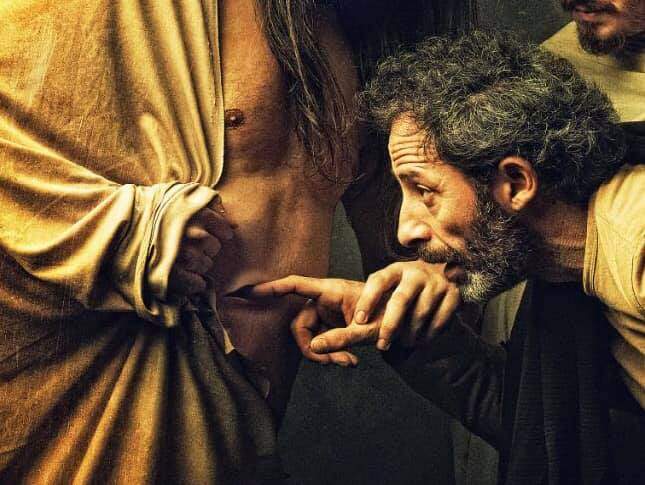
It makes sense now why, the first thing the risen Jesus did when he appeared to his disciples in the upper room was to call attention to his hands and his side. He was teaching them how to deal with their own woundedness if they wanted to be healed and to become healers themselves. They had to be like bruised little children whose bravery is tested when they are asked to show their wounds to have them touched,cleaned, and dressed for a cure.
I imagine the hurting words that these guys were able to say toward each other when they retreated in that upper room after Jesus was executed on the cross. Perhaps a good parallel is what happens to people who have spent too long a time under quarantine together to the point that they get into each other’s nerves.
They must have rubbed in to Peter the fact that he had sworn to be ready to die for the Lord; he didn’t even have the courage to stand for Jesus before a maidservant. They must have ridiculed James and John too who wanted to be positioned at his right and left; they were quickly gone when the going got rough. (Of course we have at least one Gospel claiming that John was there. Don’t ask me who wrote it though.)
They must have asked each other “Where were you when he was arrested? When he was sentenced to death? When he was crucified?” Luke tells us that two disciples had in fact already decided to quit; they had decided to retreat to the nearby village of Emmaus. These disciples shared only one thing in common after Jesus died; they were all badly wounded and traumatized.
There is no end to our capacity to hurt one other, not just physically but more painfully–emotionally, spiritually. Our cruel words can cut, and the wounds can be really clean and deep. These guys were no exception.
That is why the real proof to the resurrection is not an empty tomb; it is rather the fact that the disciples held on together after what had happened on calvary. Even before Jesus there had already been many other leaders of movements who were also thought to be messiahs but whose projects ended up as a failure and who were eventually called “messianic pretenders”. Some of them also ended up on the cross. But their misadventures simply died a natural death and their movements fell apart after they were executed. Because their members had no reason to stay together anymore, they merely disbanded.
The best evidence to the resurrection is not the empty tomb; it is rather the Church, the community of disciples that stayed together through thick and thin, and have remained in existence for the past two thousand years.
They found their way back to each other’s company, surmounting conflicts and mutual hurts, learning to forgive and to love each other with the love of Jesus. This is expressed beautifully by the first reading from Ephesians 2: “Through him the whole structure is held together and grows into a temple sacred in the Lord; in him you also are being built together into a dwelling place of God in the Spirit.”
After explaining what I call the possible background to the nickname Didymus or Twin and why it was given to Thomas, someone asked me: “So why did the nickname stick with Thomas even after he had already confessed Jesus as his Lord and his God and had already outgrown his double-mindedness?” My answer is, “Well, I suppose he took pride of the name himself and gave it a new meaning: like, a Jesus look-alike, or a Jesus twin?” Would you mind being called a twin brother or sister of Jesus?