
Bangon, Oragon!

Extra-Oil, Extra-Faith
November 8, 2020
The Call to Servant Leadership
November 10, 2020
I was there before it happened – Typhoon Rolly, I mean. I went to that now badly-battered part of the Bicol Region in October 2019. It was my fifth trip to that part of the country. The first was in 2002 as part of a group that went on an exposure trip to Legazpi to learn more about the Diocese of Legazpi and Consuelo Foundation’s Child Abuse Protection and Intervention Unit (CAPIU).
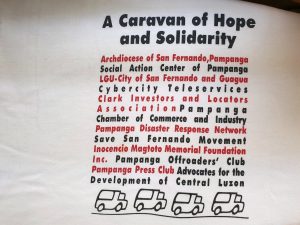
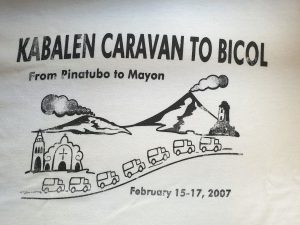
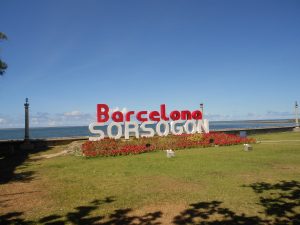
The second was in 2007, as part of the Kabalen Caravan to Bicol: From Pinatubo to Mayon. At that time, Typhoon Reming wreaked havoc on various towns of Albay and we thought it our duty as Pinatubo survivors to lend a helping hand. It was meant as a gesture of gratitude for the help that we received when we were in need. My third trip brought me farther to the tip of the Bicol Peninsula in 2015 as a delegate to the 9th Biennial National Convention of Church Cultural Heritage Practitioners. Mt. Bulosan was restless,but its flaring temper was not enough to dampen our enthusiasm to know more about the tangible and intangible treasures of Sorsogon.
My fourth trip was in 2018 in time for the celebration of the Peñafrancia Festival. Our hosts were Fr. Jun Chavenia and Msgr. Crispin Bernarte of the Diocese of Legazpi. With them was a seminarian named Miguel Obias III who is fond of cooking. I had heard so much about the Bicolanos’ devotion to “Ina” (Our Lady of Peñafrancia), Patroness of Bicol. I wanted to see for myself how they carried out the rituals attached to their devotion. I was curious about the traslacion, the voyadores, the fluvial procession, the Union of Bicol clergy, and Bicolano spirituality. I would have been contented to watch from afar, but things turned out differently.
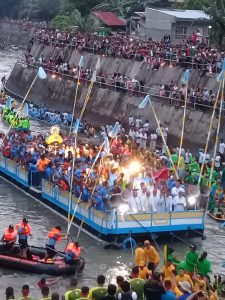
The pagoda bearing the image of Ina
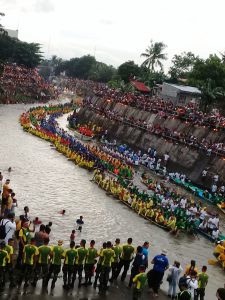
Ina’s Voyadores
On the eve of the fluvial procession, as our party of three (composed of Fr. Jun Chavenia, Sr. May Cano and myself) was waiting for the opportunity to pay a courtesy call on Bp. Joel Baylon, we chanced upon Fr. Jun’s friend, a nun named Sr. Edith Pastor DM who belongs to the Daughters of Mary congregation that has been acting as caretaker of the centuries-old image of Our Lady of Peñafrancia at the Basilica Minore in Naga. We were at the Naga Metropolitan Cathedral and Ina was scheduled for vesting that night. We knew that it was not meant for the public eye. It came as a pleasant surprise when we were quietly invited to the “dressing room” to witness the ritual.
It seemed like forever before we were ushered into the small room. In truth, we only waited for a few minutes but our growing excitement and anticipation of meeting Ina up close made us restless. Inside the room were Bp. Baylon, Sr. Edith and a few others who were waiting quietly for the ritual to start. We were briefly introduced to each other before Sr. Edith led the group in the praying of the Holy Rosary.
Dressing up the image of a revered figure like Our Lady of Peñafrancia is a sacred tradition to Catholics. It involves camareros/as, caretakers appointed by church authorities to ensure the maintenance of the image by dressing it up regularly, cleaning it, and caring for it the way we care for a loved one. In the early ages of Christianity in the Philippines, wealthy families bequeathed treasures (e.g. farmlands and jewelry) to the images of their favorite patron saints. It was called “mitra” and whatever was earned from it was spent on the upkeep of the image and mounting of the traditions and rituals attached to their devotion. With the implementation of land reform in the country, mitra became a thing of the past.
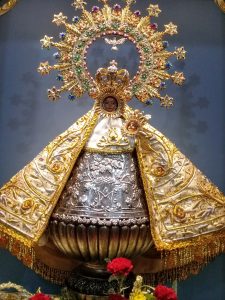
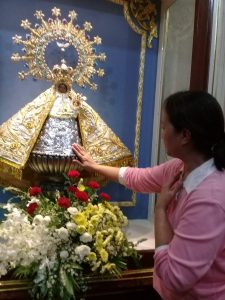
We continued praying while the caretakers were deftly putting on the vestments and fussing over the adornments with care but with much precision. Only them were allowed to touch the image while the ritual was going on. One could tell that what they were doing was sacred to them. The ritual began with prayers and ended with prayers. After the vesting, Fr. Jun and Bp. Baylon took turns carrying the image of Ina in a mini-procession that ended at the central niche right below the huge image of the Crucified Christ at the cathedral’s retablo.
When the image was safely ensconced in the glass case, we gathered at the lounging area to gush at the serendipitous experience. Our Bicolano companions appeared to be in a daze, seemingly suspended in disbelief over the good fortune of getting close to the centuries-old image of Ina.
“Do you have any idea how fortunate you are?” asked Fr. Jun. I looked at him questioningly not knowing what to say. “Every devotee dreams of getting the chance to touch the image. Most of them die without fulfilling this dream. And here you are first-time attendees being accorded that rare opportunity to get up close with Ina.” He intimated that it was his first time to witness the vesting, too and he felt privileged to have had the chance to carry Ina. Sr. May and I were awestruck, we both fell silent.
Every time it becomes obvious to me that an unseen hand orchestrates things to lead me to a serendipitous encounter with the Divine, I always ask, “What are you trying to tell me? What do you want me to do?” I found myself telling Ina: “One day I will come back and write your story.”
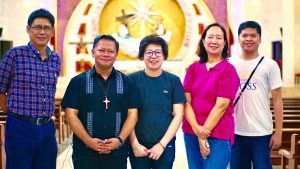
The Storytellers’ Society Inc. research team with Bp. Rex Alarcon of the Diocese of Daet (2nd from left) and our host, Christopher Dy-Liacco Flores (letfmost).
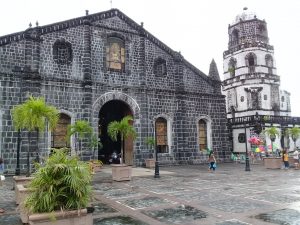
St. John the Baptist Church in Tabaco, Albay is a National Cultural Treasure.
And so I did just that— a year ago. In October 2019, I was part of a team sent by The Storytellers’ Society, Inc. (TSSI) to document Bicolano (church) heritage. Our group of three was to do interviews with historians and church figures, take photos and videos of heritage churches, people, and places related to Bicolano faith and culture. We were to put these together as sample episode for our E-Trail Project, an ambitious project that aimed to build a repository of resources on the Catholic faith of every diocese throughout the country.
For this particular trip, our host was my college batchmate and dormmate, Christopher Dy-Liacco Flores. The last time I saw Tope was more than three decades ago. I just found him via Facebook when he commented on a post of Bp. Ambo David about Bishop Jorge Barlin, “the first Filipino bishop of all times.” Tope was the perfect host for this trip. He drives like a Formula One driver, is knowledgeable about the role that Catholic priests played during the revolution and has ties with the office of Rep. Joey Salceda who has been actively promoting Albay as a premier tourist destination. It helped that Tope keeps a circle of friends (including Dr. Stephen Henry Totanes, Dr. Danilo Gerona, and Abdon Balde, Jr.) who are among Bicol’s finest historians and writers.
Our six-day trip took us to various destinations in the Bicol Region – Daet in Camarines Norte; Baao, Naga and Lagonoy in Camarines Sur; Oas, Ligao, Guinobatan, Tabaco, Tiwi, Daraga and Bacacay in Albay. We went back to Manila with a treasure trove of footages, interviews and drone shots about the faith and the cultural heritage of the Bicol Region. It was by no means complete, but we had gathered enough to do a sample episode. The Archdiocese of Nueva Caceres that covers the Bicol Region has six suffragan dioceses. We only covered three but this trip sealed my affinity with the oragon spirit.
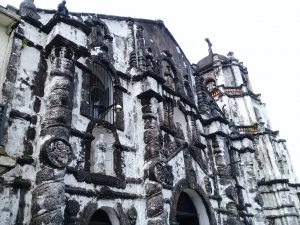
Facade of the Nuestra Señora de la Porteria Church (Daraga, Albay) which is considered as a National Cultural Treasure.
“What does oragon mean?” we asked Tope. He flashed a naughty smile. In the past, the term “oragon” was used in reference to virility and sexual prowess. It later evolved into something more positive—a slang for bravery and fortitude. An oragon is now known as someone who determinedly stands up for his/her principles.
Bangon, Oragon! is now the battlecry of a populace that is down on its knees after a series of destructive typhoons that have been coming one after another in the middle of the Covid 19 pandemic. If the names of the towns I enumerated in the previous paragraph sound familiar, it is because these are the same towns that were badly hit by Typhoon Rolly. It breaks my heart to look at the images of destruction and devastation in these places knowing how these looked like before Typhoon Rolly.
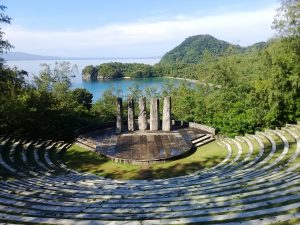
Eco-park Ampitheater overlooking Misibis Bay
Bicol has always been a favorite destination of natural calamities. The majestic Mayon that stands proud and beautiful with a ubiquitous presence can turn violent at times. Amazingly, even at its tempestuous moments, it remains majestic but deadly as it spews out volcanic debris that flows down as lahar when typhoons dump a large volume of water in the area surrounding it. Ever since I could remember, Bicol was the go-to area of strong typhoons.
In the late ‘80s, I had a co-worker from Sorsogon who lamented this fact. We were then based in Dagupan, Pangasinan. One day, she heard the news that another strong typhoon was headed towards her home province. She worried a lot and shed some tears as she asked, “Why do these strong typhoons always head to the Bicol Region? What have we done to deserve this?” She sent a telegram to herself saying that she needed to come home because of an emergency. She planned to present it to our boss as summon from her parents in Bicol. In truth, she was worried about the safety of her family as the strong typhoon battered her home province. Back then, when digital technology was just a dream, the telegram was one of the primary means of communication. One had to line up at the PT&T office to transmit his/her message to a loved one. The shorter the message the better; cost depended on the number of words.
In October 2007, following the onslaught of Typhoon Reming in 2006, the Diocese of Legazpi thru Aux. Bp. Lucilo B. Quiambao initiated the praying of an Oratio Imperata for deliverance from calamities. Mercifully, it was an effective way of warding off strong typhoons and other calamities albeit temporarily. Bicol’s geographic attributes, while partly responsible for the region’s natural beauty, make the region prone to calamities and disasters. In one of my trips, I mentioned my observation that while poverty is evident, hunger is not a problem in this area because of the abundance of natural resources from the land and the sea.
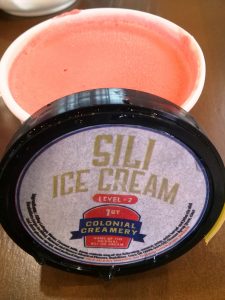
Are you an Oragon? Then it has to be Level 3 for you.

Famous Tiwi Halo-halo
What is the distinctive characteristic of Bicolano spirituality? I posed this question to my kapamilya, Msgr. Crispin Bernarte, Jr. who was Vicar General of the Diocese of Legazpi and Parish Priest of Our Lady of Fatima Parish in Legazpi at that time. “Oh, what a question!” he said. After giving it a careful thought, he gave this reply: “We always start our greetings with Dios: Dios mabalos (thank you); Dios marhay na aga (Good morning), Dios marhay na hapon (Good afternoon). If this can be taken as an indication, then you can say that Bicolanos are deeply religious,” he replied.
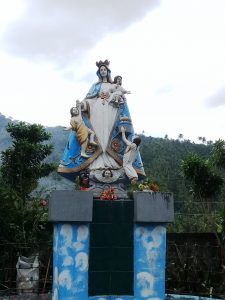
Image of Nuestra Señora de Salvacion at the Joroan Shrine
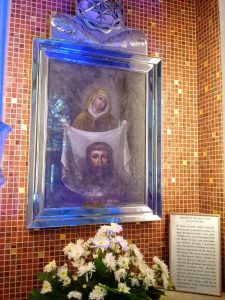
Image of the Divino Rostro, Ina’s Miraculous Companion
I believe him. I believe that the oragon spirit will prevail. It is born of a deep faith in the Divine and of a collective memory of triumph over past adversities. Bicolanos will undoubtedly bounce back in no time at all with a little help from those among us who were spared from the ravages of Typhoon Rolly. This is bayanihan spirit at work in every Filipino.


