
BE STILL, MY TROUBLED HEART

Bulong ng Langit.
February 19, 2021
To Please God, Not Men.
April 5, 2021
Yesterday, Good Friday, I woke up to stillness and deathly silence around me except for one strange noise that I’ve been hearing these past few days. The lull in activities gave me the chance to reminisce about Good Fridays past.
In my hometown of Lubao, which is acknowledged as one of the two earliest settlements (the other being Betis) where Christianity took root in Pampanga, Good Fridays were made solemn by religious rituals on one hand, and folksy by popular beliefs on the other hand.
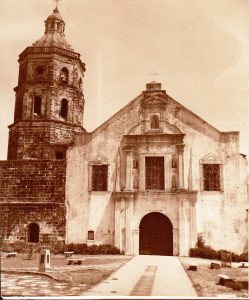
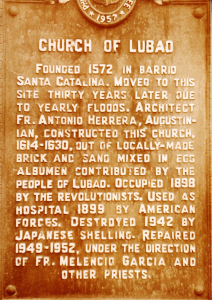
Facade and bell tower of Lubao Church (San Agustin Church of Lubao). Photo from the Venancio Q. Samson Collection, ASF Digital Archives
Our family spent Good Friday this way: No music, no tv shows, no laughing out loud. All meals for the day were lean and meat-free. Even before we reached the minimum age for fasting, Ima encouraged us to practice it. “You should only have one full meal for the day; the rest should be half of what you usually consume,” she said. There was an additional instruction: once we stood up and walked away from the dining table, it meant the full meal was over and we could not go back to our seats to eat anything. Never mind if one just stood up to get dessert from the refrigerator. Ima was that strict. She prided herself on being an “interna” who grew up under the watchful eyes of the German Benedictine sisters who were running Assumption Academy (now known as St. Scholastica’s Academy of Pampanga) then.
It was Apung Dadong, my maternal grandfather, who started the ritual of taking us to neighboring areas in the morning of Good Friday to see the penitents who took it upon themselves to “bear the cross and sufferings of Christ” literally by physically punishing themselves to atone for their sins or to ask for Divine intervention in behalf of loved ones (e.g. healing from illness). To them, it was a prayer and a sacrifice; to us children, it was a spectacle.
After breakfast on Good Friday, Apung Dadong herded me, my sister, my cousins, and our helpers to his jeep – the same one he used to go to the barrios to visit his patients – and drove towards Sta. Cruz in Lubao, then on to San Isidro in Guagua. We encountered three kinds of penitents along the way – the “mamusan krus”, penitents in maroon robe who walked barefoot while carrying a wooden cross; the “magdarame”, flagellants who beat their backs with a whip made of thick rope and thin strips of bamboo; and the “magsalibatbat”, penitents who threw themselves onto the ground under the scorching heat of the summer sun. They were naked from the waist up and crawled on their bellies or lay on their backs on the unpaved roadside. Most of the penitents covered their faces with a piece of cloth. I felt nauseous whenever we chanced upon a group of magdarame with their bloody torsos and their blood-stained whips. A haunting click-clacking sound set the cadence of self-flagellation. We were told that before the flogging began, they had their backs wounded with a shard of glass; hence the bloody torso.
At 12 noon, the Seven Last Words commenced. Television stations resumed operations at mid-day to air it live with their respective set of speakers. We made an effort to catch it live in our own parish church which was just a block away from home. The rituals came in succession – the Seven Last Words and Apung Tanggal, Veneration of the Cross, and the Good Friday procession in that order.
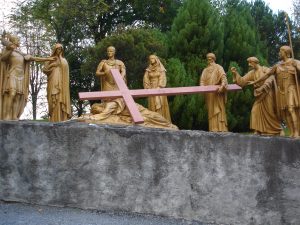
Among our parish priests, it was Msgr. Greg Binuya who was blessed with the eloquence not only to make people listen attentively but to make us feel the pain of Christ’s passion. We couldn’t help but shed tears as Msgr. Greg reached the highest point of his talk. His own voice broke as he spoke. The Seven Last Words ended with a visually haunting simulation of the death of Christ through Apung Tanggal. The life-size image of the Crucified Christ had a movable head that bowed down at exactly 3 p.m. as cymbals clanged and a play of lights made it appear like there was thunder and lightning as Christ breathed his last. The emotionally-charged scene ended when Jesus’ body was taken down from the cross by men dressed as apostles.
The Liturgy of the Veneration of the Cross with communion came next. Back then, we called it misang putut, an incomplete mass. It was actually not a mass but a ritual honoring the cross as instrument of our redemption.
Good Friday in Lubao culminated with the longest procession in our sleepy town. It snaked through four barangays of the town, namely San Nicolas 1st, Sto. Tomas, San Juan and Sta. Lucia. “Mikit ing prusisyon,” was how people described it. Barely had the last row of procession participants left the church grounds than the first carroza bearing St. Peter entered the church yard. Locals who had migrated internationally or locally reconnected with their roots on Holy Week. Ima told us that in olden days, people from the barrios traveled all the way to the plaza aboard their garetas (carabao-driven cart) to participate in the Holy Week rituals.
Our home was along the procession route. Before joining the long line of procession participants, we waited for the calandra, the glass-cased carriage of Sto. Entierro, to pass by. Devotees pulled the sampaguita-adorned calandra using two thick ropes on both sides of the road as part of their panata. The last carroza was that of the Mater Dolorosa. The town’s violinists preceded the carroza, playing the haunting strains of “Stabat Mater” as they walked along.
I participated in a ritual called paso when Msgr. Binuya introduced it during his term. He invited girls to join the Good Friday procession donning violet robes with a matching veil to cover the face. We were made to carry replicas of the tools used in crucifying Christ. These replicas were attached to wooden poles. Mine was a chisel; my elder sister’s was a saw. Another innovation added by Msgr. Greg to Lubao’s Good Friday rituals was the lamê (wake) after the procession. People lined up inside the church to pay their last respects to the dead Christ. At the end of the Good Friday rituals, the whole community lapsed into silence once again. Many took it as a time to rest, or a time to reflect, or to synthesize their experiences.
The stillness and quietude wore on till Black Saturday. “Mete ya ing Guinu! The Lord is dead!” old folks would say. Our helpers recalled how they were prohibited from taking a bath on Good Friday because the water was considered dead, too. We reacted with a loud “Yuck!” to this. How could one stand the heat and not take a bath on a summer’s day?
Ima did not allow us to play any kind of music on Good Friday and Black Saturday. The television screen was on static mode. It came to life in the late afternoon. We huddled in the living room to watch “The Ten Commandments” or “The Robe”. Our Holy Week was not complete without any of these two Lenten staples.
Fast forward to Black Saturday of 2021. People are locked inside their homes. The silence and stillness persist. The noise I’ve been hearing for more than a week now persists as well. It is the irregular beat of a troubled heart – a heart that beats erratically out of fear, anger and confusion.
There are people I know who have been infected with COVID 19. “We are sorry, there is no more room for you here,” they are told by hospital staff. “Panunuluyan” is happening at lent. People are dying in their cars or in makeshift tents while waiting for admission to healthcare facilities. Worse, the healthcare workers themselves are getting infected one by one. Why, Lord?
How has it come to this? It is as if hell’s gates were opened to let loose all evil creatures intent on sowing discord and confusion here on earth. Many of them landed on our shores. They show no remorse for the people they’ve killed, for the public funds they’ve pocketed, for their insensitivity to the plight of the poor. Why, Lord?
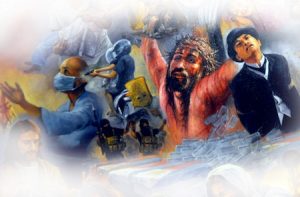
Portion of a mural at Apu Shrine in Angeles City. Years after it was installed, the images shown here have come to life (e.g. man wearing surgical mask, masked killers aboard a getaway motorcycle, etc.) Photographed by Lucio Sison
In this distressed state, I imagined the Lord when He calmed the storm at sea. What if He was the one who was wide awake as the violent squall sent waves thrashing against the boat and tossing it like it was made of paper while the apostles were the ones who were asleep (or at least pretending to be deep in sleep)? No matter how much He tried to wake them up, not a single one of them got up to help keep the boat from capsizing. “Wake up! Do you not care that our boat is sinking? I need helping hands for all of us to survive,” He said. There was no response from them. Jesus knew they were wide awake but they kept their eyes closed in fear. As Filipinos would say,”Mahirap gisingin ang taong nagtutulug-tulugan.” It is next to impossible to rouse someone who is just pretending to be asleep.
When Jesus began to bail out the water that was beginning to fill the boat, his companions opened their eyes and Jesus saw the fear that paralyzed them into inaction. When Jesus said, ”Quiet! Be still!” he was addressing not the violent squall but the storm that was raging in their hearts and minds. Their anxieties melted away and they began to move when they heard the Lord’s words. They knew that He was in control.
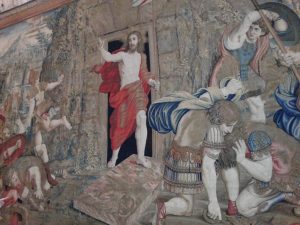
What does it mean when someone else is in control? It means that things will not always sway in one’s favor. There will be good times and there will be bad times, but the good will always prevail. This is the message of Holy Week.
Among all the Holy Week rituals, Easter Vigil is my favorite particularly that part where one renews his/her baptismal vows. The first time that most of us were baptized into the Catholic faith, we were too young to understand the meaning of it, of what we were making a commitment to. The renewal of baptismal vows every Easter Vigil accords us a chance to say “Yes” wholeheartedly, fully aware of what it entails.
There will always be lights and shadows but where hope ends, grace begins. It is one thing to know that God is in control and another thing to allow God to be in control. Such is grace. It has the power to calm our troubled hearts.
A Grace-filled Easter to everyone!


