BLESSED TO BE A BLESSING

Save the House, Don’t Run
August 14, 2020
Loving in the Here and Now
August 15, 2020Homily for Friday of the 19th Week in Ordinary Time, 14 August 2020, Vigil for the Feast of the Assumption, Luke 11: 27-28
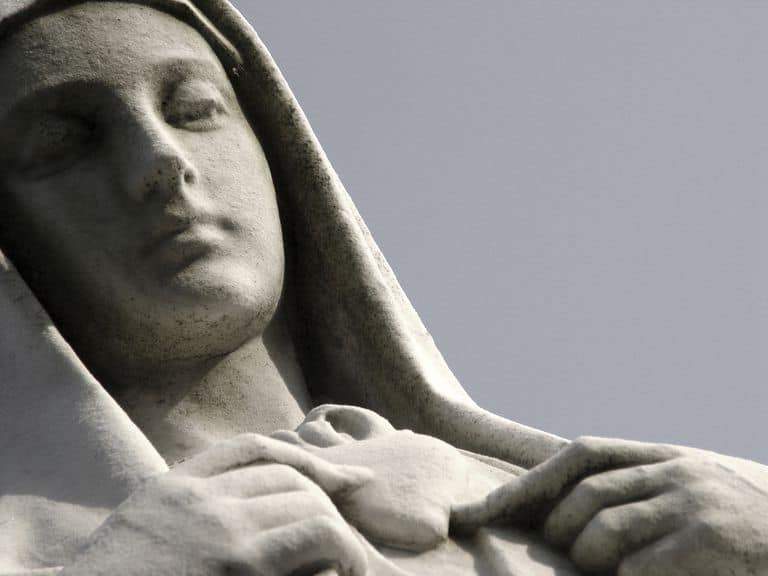
The Gospel that we read is about Jesus himself making a declaration about his mother. It is a very appropriate reading for this Vigil Mass in honor of the Blessed Mother, on the eve of the Feast of her Assumption.
I actually meant to celebrate today the Memorial of a Franciscan martyr, St. Maximilian Kolbe. But why am I wearing the white of the Blessed Mother than the red for Maximilian’s martyrdom? Because I am inclined to believe that St. Maximilian Kolbe would have preferred it that way. If he were to celebrate this Mass himself, he would have opted to focus on the Blessed Mother than on himself, because that is how this great Marian devotee had lived his life anyway.
This reflection will therefore have two parts: the first, on Mary; and the second, on Maximilian Kolbe.
Let’s start with the Blessed Mother. The very short Gospel that we read from Luke 11:27-28 tells us that an admirer of Jesus, who probably did not even know Jesus’ mother personally, exclaimed: “What a great woman your mother must be, to have raised so great a person such as you!” In short how blessed she is to be your mother!
In reply, Jesus says, “How blessed, rather, is the one who hears the Word of God and keeps it.” What is Jesus trying to say here? In simpler language, he is saying, “My mother is indeed blessed, because she is a blessing.” Not only did she welcome God’s word in her life; she allowed this word to take flesh in her womb so that she could give him to the world to bring about its redemption.
Sometimes we are fixated on Mary and think we are honoring her that way. Her own son tells us that we honor her more if we focus instead on what she lived for. She allowed her whole life to be an instrument that would bring God’s Word to the world. She is blessed because she lived her life as a blessing to the world.
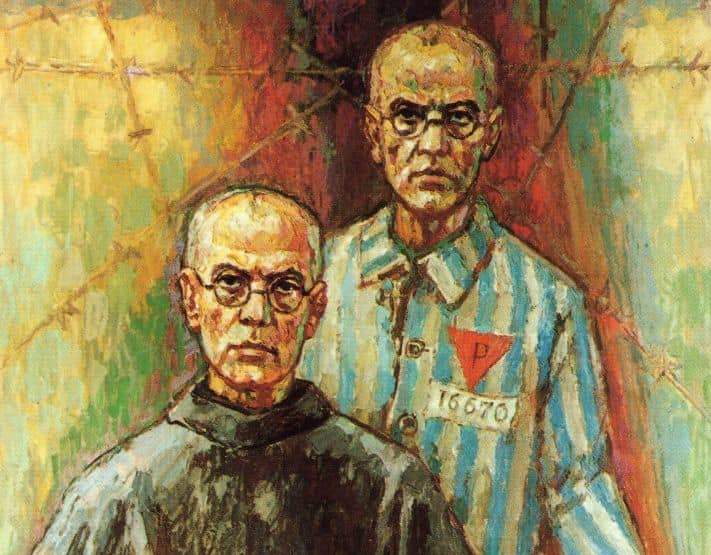
And that brings us now to St. Maximilian Kolbe, this Franciscan who was deeply in love with the Blessed Mother. He was himself a very gifted man, very blessed in many ways. He was intellectually brilliant; he finished both a Doctorate in Philosophy and a Doctorate in Theology and became a great organizer, a publisher, and a founder of one of the biggest Marian movements in the world called “Knights of Mary Immaculate”.
Maximilian was actually born of a German father and a Polish mother. When he returned to Poland in 1941 after successfully establishing his communities in other parts of the world, he found out that his country had been invaded by the Nazis. The racist Nazis who were obsessed about the superiority of the so-called Aryan race, gave Maximilian the option to define his racial profile as a German since his father was German, and thus enjoy all the privileges. But he chose to renounce German citizenship. Out of principle, he opted instead to be Polish, because could not stomach the racism of the Nazis, and their oppressive and fascist ways.
Maximilian could have saved himself that way. But then, you see this man was never concerned about saving himself. Rather, he made a principled stand, having seen the godlessness and the inhumanity of the Nazis. He dared to defy them and support the resistance to the Nazi ideology by publishing their subversive literature.
Listen to what he said about them: “These Nazis will not kill our souls, since we prisoners certainly distinguish ourselves quite definitely from our tormentors; we will not allow them to deprive us of the dignity of our Catholic faith. We will not give up. And when we die, we die pure and simple, resigned to God in our hearts.”
He found the opportunity, not just to make this statement, but to live up to it, when, on July 30, 1941, while he was a prisoner at Auschwitz, one prisoner had escaped. This had so angered the commandant that, perhaps to warn all the others about the consequences of escaping from prison, lined up the inmates of Cell Block 14 and ordered ten of them to be selected for punishment. They would be consigned to an underground bunker and starved to death.
One of them, a certain Francis Gajowniczek, began to plead for his life in tears saying that he had a wife and children waiting for him. At that, Maximilian Kolbe stepped forward and volunteered to take the man’s place. He remained alive to encourage his nine other companions in the bunker. When the Nazis found out that he was still alive, they decided to give him a lethal injection on this day, August 14, 1941, and had him cremated afterwards.
Maximilian reminds me of that Talmudic saying, “To save one man is to save the whole of humanity.” In the midst of the inhumanity of the Nazis, he stood his ground and witnessed to the nobility of the human spirit by offering his life for the redemption of another man who wanted to survive for the sake of his family.
You know, that person was still alive, and, along with his children and grandchildren, he stood beside Pope John Paul II when Maximilian Kolbe was canonized in 1982. The Pope cited Maximilian Kolbe as a true witness of the words of the Gospel of John: “There is no greater love than to lay down one’s life for one’s friends.” Like the Blessed Mother Mary whom he loved dearly, it wasn’t enough for Maximilian to be BLESSED. He felt more truly blessed by being a BLESSING, by allowing God’s Word to take flesh in him, for the redemption of humanity.