
The Power of Storytelling

Sana Tatlo Para Kumpleto.
January 22, 2021
Oo, Ikaw nga. Wala ng Iba.
February 19, 2021
“Oh look! There’s Mateo with his dog. They are on their way to the market.”
I looked closely and I found Mateo walking beside his dog. Every day, I followed Mateo’s adventures till he became part of my world. Mateo was a fictitious character brought to life by my sister’s creative mind. Our daily storytelling sessions happened inside our toilet at the ground floor while she was pooping. While she sat on the toilet bowl, I sat on a wooden stool listening intently to her stories. Our toilet downstairs had concrete walls with encrusted pebbles of various colors, shapes and sizes. With a little imagination, our minds created patterns and designs that we weaved into stories. At times, we’d imagine seeing the face of the Blessed Mother, or Jesus or angels. Sometimes, we’d see a fearsome monster ready to pounce on unsuspecting creatures. In that tiny toilet, we found imaginary friends like Mateo.
Ating Heidi’s animated storytelling made me ignore the smell of her poop and the fact that it was all a ploy to keep her company. As we advanced in age, when her ploy stopped working, she continued telling me stories. When we came home from school, she’d take out her pad paper that had sketches of a row of structures that included a market, a gas station, a school, church, and practically everything that a community needed to be self-sufficient. In truth, those structures were just squares, rectangles and circles that she put together and populated with imaginary human beings who moved around and lived happy lives in that make-believe community. Ating Heidi’s stories came complete with dialogues.
Ating Heidi was not the only one who regaled me with her stories. There was also Apung Ya, my maternal grandmother – a retired public schoolteacher who imbibed the habit of having recess every 10 am daily. At the stroke of 10, she’d take out a pitcher of cold water from the refrigerator, add a spoonful of Sunquick orange or freshly squeezed calamansi and sugar to it to make a refreshing drink. She’d then take out a canister of cookies or biscuits – Jolly or Hi-ro or butter cookies. My favorite was the Kapampangan version of otap called talampakan from El Gusto Bakery of Guagua. It was sweet, crunchy and as large as the soles of the feet, hence the name talampakan.
While Apung Ya was having snacks, she’d regale me with stories about her youth as pampered daughter of a rich haciendero who owned large tracts of land in Potrero, Bacolor. I listened intently as she narrated how her fairytale-like existence turned into a nightmare when her father died and their family woke up one day to the news that they had nothing left. As eldest among the females, she had to help put food on the table by teaching in public schools in various towns of Pampanga. Her stories helped me understand why she valued every penny that she had and why she recycled everything including gift boxes and wrappers. I learned as much from Apung Ya’s stories as I did from formal classroom lessons.
When I discovered my passion for writing and storytelling, I explored various genres beginning with campus journalism when I was 12 years old then on to playwriting to technical writing to creative writing. The artist in me begged to share space with the scientist in me. The artist eventually won and worked in tandem with the social development worker in me, according me close encounters with life itself – the good and bad of it – poverty and plenty, mercy and cruelty, love and hatred, hope and hopelessness, joy and sorrow. I have since opted to write stories about these encounters as creative non-fiction narratives.
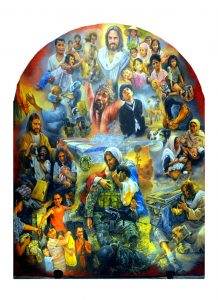
Mural of Mercy at Apung Mamacalulu Shrine in Angeles City (Photo by Lucio Sison)
Readers are familiar with personal essays, memoirs, feature stories, biographies, auto-biographies, documentaries and other forms that combine the rigors of fact-telling with the art of storytelling using literary devices; but the label “creative non-fiction” is relatively new. Some of us (including myself) belong to a generation that frowned on stories written with a first-person point of view. It was deemed inappropriate, immodest, and self-serving in the past. The advent of social media changed that perception. Creative non-fiction shared via social media has given voice to those who were once voiceless. Nowadays, we are all voyeurs who take a peep every now and then into the lives of other people. There are attendant risks, of course and it is prone to abuse; one just has to look at the proliferation of fake news as example. It has its rewards, too, when utilized as tool to spread good news.
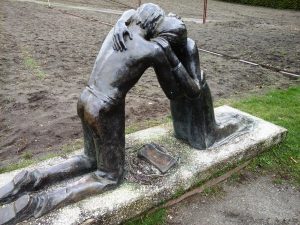
RECONCILIATION sculpture in Berlin, Germany by Josefina de Vasconcellos The image paints a thousand words.
There are a thousand and one ways to tell a story – through images or words, or both – in motion or in stills, with or without rhyme or rhythm, through poetry or music or dance or theater or literature or sculpture or painting. Whichever form one utilizes, storytelling is a tool that has the power to connect, to heal, to educate and to bring about catharsis.
Storytelling creates an invisible web that connects people When we tell real-life stories about real people, we cannot afford to be distant. We become involved and we learn to put ourselves in the shoes of our subject. And so, we dig deeper and learn to investigate the circumstances of our subject. What is his/her backstory? What shaped his/her character? Unlike fiction, endings of non-fiction stories cannot be altered to suit a writer’s purpose or plot.
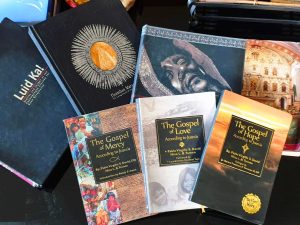
The Gospel According to Juan/a collection tells true-to-life stories of real people.
I was once involved in a project on corporal punishment of children. One of the methods employed to gather data was to engage the children and the parents in separate storytelling sessions with them as storytellers. First, they were asked to tell their stories through drawings/illustrations; then they were asked to tell the stories behind the images they drew. What words failed to reveal, the images depicted vividly and vice-versa. Sessions like these could lead to communal or individual realizations that could prove to be therapeutic for both storyteller and listener.
Sometimes, real life situations and circumstances involve characters who are far more complicated than fictitious ones. Truth is stranger than fiction, as the cliché goes. True-to-life stories have more twists and turns than fiction that unfolds in a writer’s head. Who would forget Kian de los Santos and his pleas: “Tama na po! May test pa po ako bukas.” Or the construction worker who lost his job and whose family got evicted from their rented house when the pandemic broke out. “Mahirap po. Lalo na sa pinansiyal. Napakahirap po,” he said in between sobs.
One might ask: “Where is hope? Where is redemption?”
On the occasion of the 54th World Communications Day of 2020, Pope Francis highlighted the value of storytelling to humanity especially to followers of Christ. He said:
“Stories influence our lives…Stories leave their mark on us; they shape our convictions and our behavior. They can help us understand and communicate who we are.”
On one hand, his message came with a warning that “not all stories are good stories.” Somewhere in the storyline, there lurks the antagonist who sows division or fosters discontent. Instead of making us realize our interconnectedness, these bad stories disconnect us from one another and from Jesus, the central character in the greatest story ever told.
On the other hand, Pope Francis reveals where we can find hope and redemption in our life stories:
“When we remember the love that created and saved us, when we make love a part of our daily stories, when we weave the tapestry of our days with mercy, we are turning another page. We no longer remain tied to regrets and sadness, bound to an unhealthy memory that burdens our hearts; rather, by opening ourselves to others, we open ourselves to the same vision of the great storyteller.” (http://www.vatican.va/content/francesco/en/messages/communications/documents/papa-francesco_20200124_messaggio-comunicazioni-sociali.html)
When I was a teen, Ating Heidi introduced me to the work of a popular cartoonist named Larry Alcala. I followed Mang Larry’s “Slice of Life” cartoon series that depicted life of the ordinary Juan/Juana in various settings (e.g., market) and situations (e.g., town fiesta, Mt. Mayon eruption, etc.). What made his work a novelty was his penchant to include himself in the scene but cleverly hidden as an inanimate object in an insignificant space or corner. The challenge was to find Mang Larry’s face in the maze of figures. He was always there; one just had to search hard to find him.
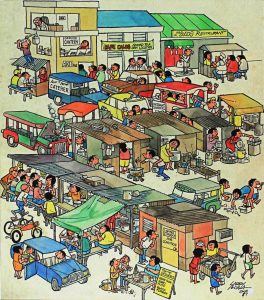
OCTOBER 27, 2018
A sample of the highly popular Slice of Life cartoon, titled Sidewalk Bistros https://newsinfo.inquirer.net/1047513/looking-for-larry-alcala-slices-of-a-creative-life
I believe this is how our stories as Christians are meant to be. There is always that challenge to find Jesus in the picture. He is always there, sometimes imperceptible, but He is there. We just have to look closely to find Him.


