
Ripples of Hope

Crossing to the Other Side.
April 17, 2021
Pahirin ang Luha, Magbabang-Luksa.
April 21, 2021
The Community Pantry dominates social media nowadays. It began in Maginhawa Street as an initiative of a young entrepreneur named Ana Patricia Non, daughter of fellow SAMASA (Sandigan para sa Mag-aaral at Sambayanan) alumni, Zena and Art. Her slogan is simple but meaningful: “Magbigay ayon sa kakayahan, kumuha batay sa pangangailangan.”
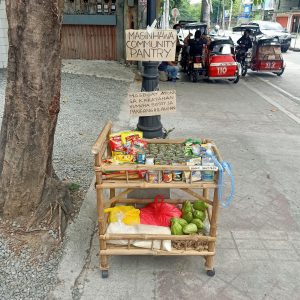
Maginhawa Community Pantry; Photo from AP Non’s FB Page
It would surprise those who hate “reds” to know that this phrase was popularized by Karl Marx in his 1875 Critique of the Gotha Program. It is said to have originated in France. Lest this bit of information enrage trigger-happy red-taggers, note that Patreng’s slogan is reminiscent of community life among the early Christians of Jerusalem. From Acts 4:35 (NABRE): “And they were distributed to each according to need…” and from Acts 11:29 (NABRE),” So the disciples determined that, according to ability, each should send relief to the brothers who lived in Judea.”
Many years ago, long before this pandemic broke out, Bp. Ambo and I were already discussing the prospect of putting up a food bank at the Apu Shrine. I do not remember what year that was but it must have been after we launched the book entitled, Apung Mamacalulu: The Sto. Entierro of Angeles City.
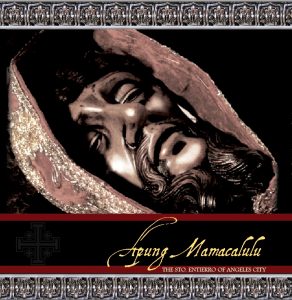
In this book, we documented the rituals, traditions and practices of devotees including leaving money – either paper bills or coins – by the feet of the image which has long been believed to be miraculous. It was like giving “abuloy sa patay”, a donation to cover the funeral expenses of the deceased. The money just kept piling up and it was likely that while there were those who came to give, there were also those who came to take. No one would have known anyway except Apu who bestows mercy upon those who seek it.
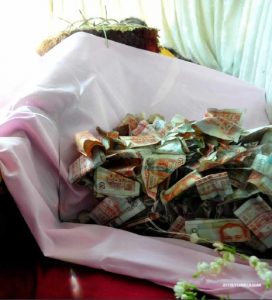
Paper bills left inside the glass coffin of Apung Mamacalulu. This was before an accounting system was established. (Apung Mamacalulu: The Sto. Entierro of Angeles City; Photo by: Jeffrey Caballa Buan)
Bp. Ambo, in consultation with his fellow priests and with parish lay leaders, established a system of collecting, accounting and utilizing the “widow’s mite” to implement programs for the poor. He was always open to suggestions. That was how we came to talk about the food bank project. “I wonder what other projects could be implemented for the poor,” he said one day. He was actually thinking aloud. I mentioned my long-time dream of putting up a food bank knowing that some homes have an overflow of food supply while some have nothing. Poverty and hunger were the contexts then; food wastage, too.
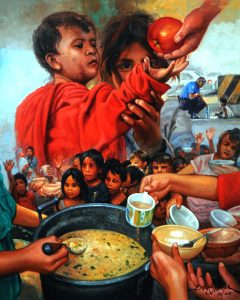
“Feed the Hungry” (One of seven corporal works of mercy paintings by Edgar Nocum); installed at the Apung Mamacalulu Shrine; photo by: Lucio Sison
In urban areas, people cope with hunger by means of “pagpag”. It is a Filipino term meaning “shake off”. It is a means of survival among the poor in urban centers where fast-food joints abound. One digs into a bucketful of refuse to fish out a half-eaten chicken from a mixture of bones, uneaten rice and meat. It is then shaken to remove particles clinging to it. Pagpag makes it good enough to eat.
Bp. Ambo mentioned an article he read about a community in Europe that installed refrigerators in accessible areas and filled these with food. Anyone in need could walk in and take food from the community pantry. “Would this work in the Philippines?” I asked. “Maybe, we have to get somebody to mind the pantry,” he said. “Well, the refrigerator has to be chained and locked lest somebody comes to take it with all the food away,” I replied half-jokingly. At that time, I was smarting from a house break-in. Thieves succeeded in carting away all our electronic gadgets including laptops, cellphones, and a television set. The case was never resolved.
“Maybe we can partner with restaurants and market vendors,” I suggested. “Let’s think about it,” he said. The food bank project did not take off. Not long after that conversation, Bp. Ambo was appointed Bishop of the Diocese of Kalookan and we focused our collaboration on publications.
What we failed to achieve, Patreng attained with her more simple and more inclusive concept: Take what you need; give according to your capacity. Patreng’s humble initiative has grown by leaps and bounds in a matter of days. With it comes a renewed sense of empowerment among Filipinos. Just a few days ago, we were all drowning in our own tears: health care professionals have declared that the country has lost the war against Covid 19, the economy is on the verge of collapse and people are dying without a fighting chance. We were all distraught until Patreng took out her two fishes and five loaves, a simple act that encouraged others to do the same.
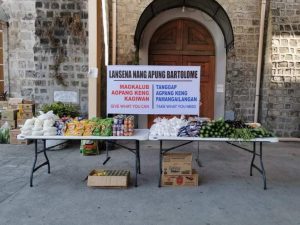
Community pantry at San Bartolome Parish in Magalang, Pampanga. Photo from the FB page of Renato Galang.
I remember a conversation I had with my father Bang about his interpretation of the miracle of loaves and fishes. “I don’t think that bread and fish miraculously multiplied to fill the baskets and feed five thousand. Surely, the people brought enough provisions with them to feed themselves, but they didn’t want to take out their baon because they thought that what they had was not enough to be shared. The real miracle happened after the boy took out his bread and fish. The Teacher did not belittle his meager contribution. He did not say, “Are you kidding? Just that for a throng of hungry people?” Instead, he uttered a prayer of thanksgiving and praise to the Father. One by one, the people began to bring out what each had been keeping in his/her bag. In the end, there was more than enough for everyone.
Bang’s interpretation appealed to me. We see it happening now. We see it every time a disaster occurs – students skip a meal or two to donate a hundred pesos to relief operations, farmers donate a portion of their harvest to help feed the evacuees, ambulant vendors donate their products to pitch in.
To a battle-weary populace who have had to contend with the ugly realities of bad governance (read: cuss words, lies, incompetence, disappearing acts, vanishing funds, killings, red-tagging, and corruption), Patreng’s initiative is the pebble cast into a pond causing ripples of goodness and hope to spread in all directions. It only takes a spark!


